Rekey or Replace? Your Locks When You Move Into a South Philly Home
You don't know how many copies of the old keys are floating around, and that's the whole reason to do something about it.
October 16, 2026 · 4 min read
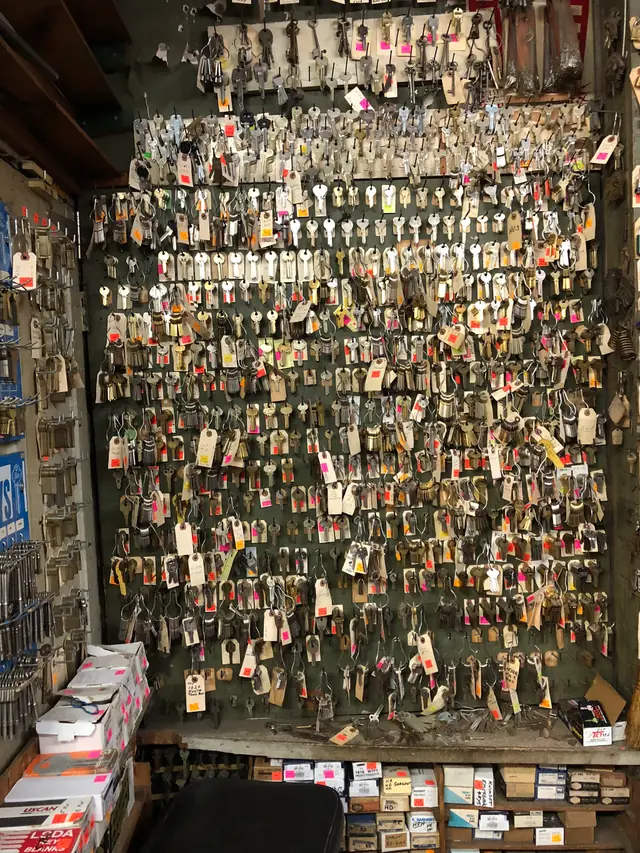
Moving day in South Philadelphia has a rhythm. The truck is double parked on a narrow street, somebody is carrying a mattress up the front steps, and in the middle of it all the previous owner or landlord hands you a small bundle of keys. It feels like the last step. It's actually the first question: who else has one?
You can't know how many copies of those keys exist. Past owners, tenants, relatives, contractors, a neighbor who watered the plants, a cleaner. None of them necessarily did anything wrong, and most people hold on to a key without a second thought. Still, your locks were set up for somebody else's life, and a new home is the cheapest, easiest time to make them yours.
What rekeying actually does
Inside a typical pin tumbler lock sits a set of small pins of different lengths. The old key lifts each pin to exactly the right height. Rekeying means taking the lock apart and swapping those pins so a new key lifts them instead, which means the old key stops working. The lock itself, the knob or deadbolt you already own, stays on the door.
Rekeying is a good fit when your hardware is in decent shape and you simply want control of who can get in. It also lets us put every lock in the house on one key, so the front door, the back door to the yard, and the basement door all open with the same one. Rekeying and installations are both on our service list, and we work on Kwikset, Schlage, Baldwin, Emtek, Yale, Arrow, Corbin Russwin and others.
When replacing makes more sense
Sometimes the lock is the problem, not the key. A replacement is worth considering if any of these sound familiar:
- The lock sticks, grinds, or needs a shove to turn, even with a freshly cut key.
- The knob or handle is loose, wobbling on its screws, or visibly worn through.
- The bolt barely reaches into the frame, or the door only has a knob latch and no deadbolt at all.
- You'd like a different style of hardware, or a code lock so there's no key to lose.
- Parts are missing, or you can't tell what brand the lock is.
One of our Google reviewers, Becca Haydu, locked herself out, and after we helped her get in, we later installed a new code lock for her "so I won't lock myself out again." That's a perfect example of a replacement that solves a real problem. Her words: "Always helpful and friendly for any hardware store needs as well." We'll take it.
Walk every door before you decide
Old South Philly rowhomes tend to have more entrances than people think. There's the front door on the street, a back door to the yard or the alley, maybe a basement or cellar entrance, and sometimes a side or roof access. Make a short list of every lock that keeps someone out, including the mailbox, the shed, and any gate. It's easy to rekey the front door and forget the one at the back.
While you're at it, look at the door itself. In older homes, wood frames shift with the seasons, and a lock that worked fine in January can bind in August. A bolt that doesn't line up with the strike plate, the metal piece on the frame, makes any lock feel bad and any lock easier to defeat. Often the fix is as simple as longer screws or a nudged strike plate, and that's a conversation worth having over the counter before you spend anything on new hardware. Bring the lock if you can carry it, or take a picture of the door edge and the frame.
How many keys, and who gets them
Decide in advance how many keys you want, and write down who has each one. Two for the household, one for a family member nearby, and one stashed in a safe place is a common setup. We recommend keeping a spare key somewhere secure, and a rekey is the perfect moment to cut that spare on a clean, fresh key. A key made from a good original works better than one made from a worn one.
If you rent
Renters, check with your landlord before changing anything. Who handles a lock change varies from building to building, and it's better to sort that out up front than to find out later. If your landlord is the one doing it, they're welcome to send the work our way. We handle both residential and commercial jobs.
Ask us before you buy anything
We offer free estimates in person or over the phone on sales and installations, so there's no need to guess. Tell us what you have, how many doors, and what bugs you about the current setup, and we'll tell you whether rekeying or replacing fits. If you bought hardware from us, we back it. Satisfaction is guaranteed on all lock installations and repairs.
A good rule: if the lock works well and feels solid, rekey it. If it's tired, loose, or doesn't suit the door, replace it. Either way, you end up knowing exactly who holds a key to your home, which is how it should feel the first night in a new place.
We're at 1113 E Passyunk Ave, Philadelphia, PA 19147, open Monday to Friday 9 to 6 and Saturday 9 to 5. Call (215) 468-4819 or use the form on our Contact page, and we'll help you sort out your new front door.
Wilensky's Hardware & Locks, (215) 468-4819
Call (215) 468-4819More articles
Why Some Keys Won't Copy at the Big-Box Kiosk
If you've ever carried a fresh copy home and watched it fail in the door, the problem is rarely you.
Master Keying for a Small Building or Shop: How It Works and Who Holds What
One key for you, one key for each tenant, and nobody carrying a ring of fifteen. Here's how that's built.