Why Some Keys Won't Copy at the Big-Box Kiosk
If you've ever carried a fresh copy home and watched it fail in the door, the problem is rarely you.
October 16, 2026 · 4 min read
You've probably done this walk. You carry a key into a big store, hand it to a kiosk or a machine in the hardware aisle, wait a minute, and get back a fresh key that looks right. You get home and it sticks in the lock, or turns halfway, or doesn't turn at all. You go back, they cut it again, and the second one is no better.
One of our Google reviewers, Cumhur Gorgun, wrote that he was trying to duplicate a key and "went to five different places, but none of them were able to do it. They did it very easily." Another, Denise, said she came to a small shop for her keys "as opposed to copying at the likes of Home Depot and co where half the time it doesn't even work." Neighbors up and down Passyunk Avenue and across South Philadelphia have said similar things over our counter for years, so here's why it happens.
A copy of a copy of a worn key
A key is a short list of measurements. Each cut along the blade matches the height of a pin inside the lock. A key that comes straight from the factory or from a locksmith's code has those depths exactly right. Now think about how long your key has lived in a pocket. Every trip in and out of the lock wears the brass a tiny amount. Keep it for years, drop it on the stoop a few dozen times, and the sharp edges of those cuts round off.
When a machine traces a worn key, it traces the wear too. The copy inherits the rounded edges, and any copy made from that copy inherits them again. After a couple of generations the key is off by just enough that the pins never line up. It looks fine and it fails.
The fix is a person who looks at your key before cutting it. A counter man who has handled thousands of keys can tell a tired original from a good one, and can tell you so. Sometimes the answer is to make a fresh key to the lock's measurements instead of tracing the worn one. Keys Created is one of the services we list for exactly that reason.
Cut versus copied
Those two words get used as if they mean the same thing. They don't. Copying is tracing: a machine follows the original and mirrors it onto a blank. Cutting, the way a locksmith means it, is making the key from measurements, with a blank matched to the lock and each cut made to the right depth and spacing.
The right blank matters before the first cut
The blank is the uncut piece of metal your key gets made from. Along the side of every blade runs a groove pattern called the keyway, and it differs between lock brands and models. A blank that's close but not exact can slide into the lock and still not turn it cleanly. Worse, it can bind, and a binding key wears the inside of your cylinder.
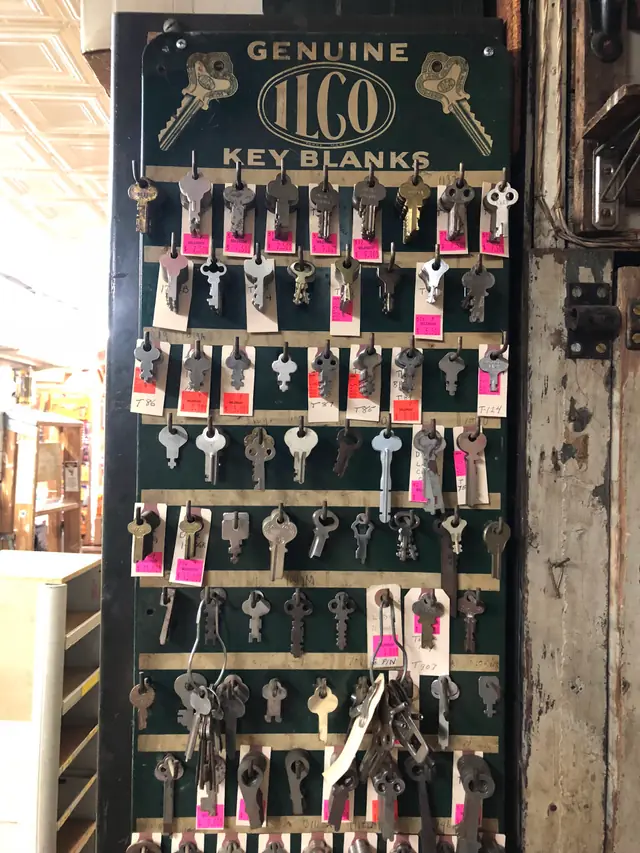
A kiosk carries a small rack and tends to pick the nearest match. A counter that stocks a wide range of blanks has a better shot at the exact one. If you've been in the shop at 1113 E Passyunk, you've seen the wall of tagged keys and the green board of Genuine ILCO key blanks. That wall is the reason we can say yes to a key that's turned away elsewhere. We service Kwikset, Schlage, Baldwin, Emtek, Yale, Arrow, Corbin Russwin, Abus, Mul-T-Lock and more, so a lot of the keys that walk in are keys we already know.
Keys that give kiosks trouble
- Designer keys: the head of the key may be decorative or colored, and the blank has to match both the shape and the keyway.
- High-security keys: many systems, Mul-T-Lock among them, use special profiles that a standard kiosk isn't set up to cut.
- Antique and skeleton keys: old keys often can't be traced at all and need to be made by hand to fit.
- Car keys: they come in more varieties than house keys, so bring the key you actually use and ask.
What to bring, and what to check
Bring the best key you have, not the most worn one. If there's a spare that has barely been used, that's your starting point. Tell us which door or lock it belongs to, and mention it if you know the lock is high security. If the key is unusual, call ahead and describe it. We're glad to talk it through.
Then test the new key before you leave the neighborhood. If you can, try it in the lock it's meant for. A copy that goes in smoothly, turns without a push, and comes out without catching is a good copy. If it fights you, bring it back and we'll look at it with you.
Keep a spare in a safe place
We recommend that everyone keep a spare key somewhere safe. The best time to have that spare cut is while your working key is still in good shape, because a spare made from a good original is better than a spare made from a worn one.
Stop by Wilensky's Hardware & Locks at 1113 E Passyunk Ave, Philadelphia, PA 19147, Monday to Friday 9 to 6 or Saturday 9 to 5, or call (215) 468-4819. You can read more about what we copy and create on our Key Duplications page.
Wilensky's Hardware & Locks, (215) 468-4819
Call (215) 468-4819More articles
Rekey or Replace? Your Locks When You Move Into a South Philly Home
You don't know how many copies of the old keys are floating around, and that's the whole reason to do something about it.
Master Keying for a Small Building or Shop: How It Works and Who Holds What
One key for you, one key for each tenant, and nobody carrying a ring of fifteen. Here's how that's built.